
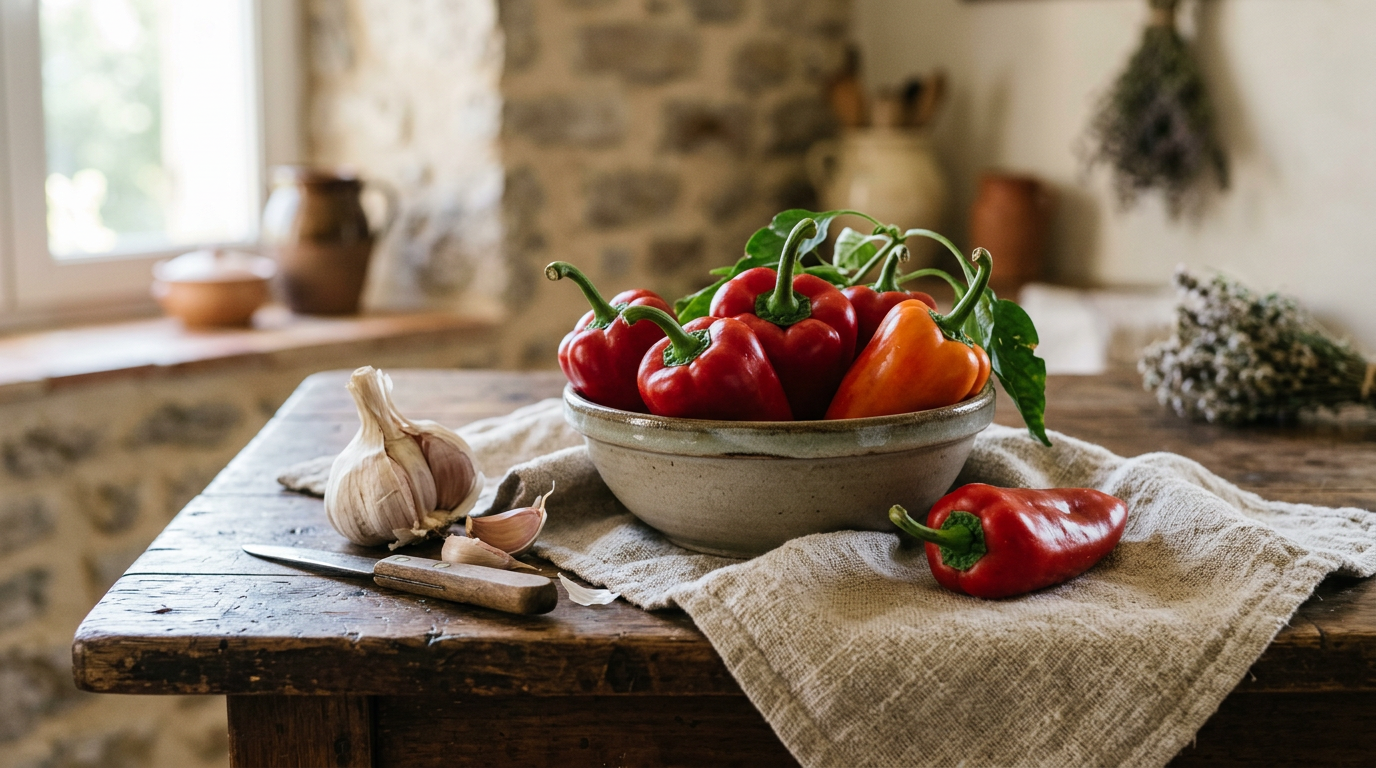
When I think of Hungarian cooking, I don’t see a specific dish first. I see a wooden spoon, a pot on the stove, and a soft cloud of paprika rising as it hits the hot fat.
That moment — the onions gently sizzling, the paprika waking up in the pot — is, for me, the true beginning of a Hungarian recipe. Paprika is more than a spice in Hungary; it’s color, warmth, history, and home all in one.
In this post, I’d love to take you behind that spoonful of red powder: where it comes from, why it matters so much, how we use it, and how you can invite a little Hungarian warmth into your own kitchen.
A short story of Hungarian paprika
Paprika didn’t start its life in Hungary, but I think it found its true home here.
The peppers themselves came from the Americas centuries ago, slowly making their way to Europe and then into the Carpathian Basin. At first, they were almost a curiosity, sometimes even used as ornamental plants. Over time, though, Hungarians began drying and grinding the peppers, discovering that this deep red powder brought not just heat, but warmth, sweetness, and a beautiful color to simple, everyday dishes.
By the 18th and 19th centuries, paprika had become inseparable from Hungarian cooking. Regions like Szeged and Kalocsa (you may recognise their names from paprika packets) turned into the heartlands of paprika production, with families passing down their own ways of growing, drying, and grinding from one generation to the next.
What I love most is that paprika was never a luxury ingredient. It was something humble people could grow in their gardens, then transform into the flavor that defined their kitchen. That’s still its magic today: a spoonful of red powder turning onions, fat, and a bit of meat or vegetables into something comforting, rich, and very Hungarian.
Not all paprika is the same: types Hungarians use
If you walk into a Hungarian pantry, “paprika” doesn’t mean just one thing. There are several kinds, each with its own personality.
Here are the main ones you’ll often see:
- Édes (sweet) paprika – Deep red, rich, and full of flavor without being hot. This is the backbone of many everyday dishes. If you buy only one type, make it this.
- Csemege (delicate) paprika – Mild, sweet, and very aromatic. It’s often used when you want a beautiful color and a round flavor without much heat.
- Édesnemes (noble sweet) paprika – One of the most famous types. It has a bright color, gentle sweetness, and a slightly more pronounced aroma. A “safe” and very typical choice for Hungarian recipes.
- Csípős (hot) paprika – This is where the heat comes in. It’s usually blended with sweet paprika to control the spice level, rather than used on its own in large amounts.
- Smoked paprika – Traditional Hungarian paprika isn’t always smoked, but smoked versions are more common these days. A little bit adds a lovely depth, especially to rustic stews.
Even the grind matters: a finer grind melts more smoothly into fat and gives a uniform color, while a slightly coarser grind can feel a bit more rustic.
If you’re cooking Hungarian dishes outside of Hungary, look for paprika that is:
- clearly labeled “Hungarian”, ideally from Szeged or Kalocsa
- a vibrant red (not dull brownish)
- stored in a sealed package away from bright light
A good paprika should smell warm, a little sweet, and inviting — never dusty or flat.
How paprika builds the soul of Hungarian dishes
If you look at many classic Hungarian recipes, they all start almost the same way: onions, fat, and paprika.
You gently cook finely chopped onions in lard or oil until soft and fragrant, take the pot briefly off the heat, and then stir in the paprika. This moment is where the soul of the dish is born. The hot fat wakes up the paprika’s flavor and color, but if you burn it, it turns bitter — so there is a tiny dance of timing and care that every Hungarian home cook learns.
Think of:
- Goulash soup (gulyásleves) – Paprika gives the broth its warm red color and gentle heat, turning simple beef, potatoes, and root vegetables into something deep and satisfying.
- Chicken paprikash (csirkepaprikás) – Here, paprika wraps the chicken in a rich, velvety sauce that is both comforting and slightly tangy, especially with a spoonful of sour cream.
- Pörkölt – A slow-cooked paprika stew, where the meat, onions, and paprika slowly melt together into something thick and intense.
- Lecsó – A rustic pepper-and-tomato stew where paprika appears twice: as the vegetable itself and as the spice, amplifying its own flavor.
In all of these, paprika isn’t just “one of the ingredients.” It is what ties everything together — the color in the pot, the warmth on your tongue, the smell that fills the kitchen. Without it, the dishes would still be food, but they wouldn’t quite be Hungarian.
How to choose and store paprika at home
To let paprika really shine in your kitchen, a few small habits make a big difference.
How to choose a good paprika
- Check the color: it should be a bright, lively red. If it looks dull or brownish, it’s probably old or of poor quality.
- Look for origin: if possible, choose paprika specifically labeled Hungarian, or from regions like Szeged or Kalocsa.
- Smell it (if you can): it should smell sweet, warm, and slightly fruity — not musty or dusty.
How to store it
Paprika is sensitive to light, heat, and air. To keep it flavorful:
- Store it in an airtight container.
- Keep it in a cool, dark place, away from the stove and direct sunlight.
- Try to use it within 6–12 months. It doesn’t suddenly go “bad”, but it slowly loses color and aroma.
If you notice that your paprika has turned brownish and has no real smell left, it’s time for a fresh packet. Your dishes will thank you.

What paprika means to me
For me, paprika is not just a spice in a jar; it’s a little red bridge back to Kecskemét, to family kitchens, to long Sunday lunches and late-night conversations over simple stews.
I grew up with the sight of paprika hanging to dry, with its scent blooming in a pot as someone stirred and tasted, saying, “Just a little more.” Every time I open a fresh package and see that deep, hopeful red, I feel a bit of that warmth again.
Cooking Hungarian food now, far from where I was born, is my way of keeping that warmth alive and sharing it with you. When I sprinkle paprika into a dish for this blog, I’m not just thinking about flavor — I’m thinking about stories, memories, and the feeling of being welcomed to the table.
If you’d like to taste how paprika lives in real Hungarian dishes, you might enjoy starting with:
- a cozy Goulash soup,
- a comforting Chicken Paprikash, or
- a colorful Lecsó full of sweet peppers.
I hope this little journey into Hungarian paprika inspires you to open your own jar, warm some onions in a pot, and let that deep red swirl into your cooking. Maybe, just maybe, it will bring a bit of Hungarian comfort into your home too.